

Rexford Industrial (REXR) owns warehouses in one place: infill Southern California. The common stock gets the attention. The preferred stock gets paid first.
Rexford has two preferred issues, both small, both ranked below the company’s bonds and above its common shares in the line for cash. This post covers what they pay, what protects the dividend and what could go wrong.
The two preferreds
Series B (REXR-PB). 5.875% coupon, which is $1.46875 a share each year, paid quarterly. $25 liquidation preference. Redeemable by Rexford at $25.
Series C (REXR-PC). 5.625% coupon, which is $1.40625 a share each year, paid quarterly. $25 liquidation preference. Redeemable by Rexford at $25.
Both are cumulative. If Rexford skips a payment, it still owes it, and common shareholders get nothing until preferred holders are caught up. Both are perpetual, so there is no maturity date.
Both trade below $25. Series B recently changed hands near $21, a yield of about 7%.
What stands behind the dividend
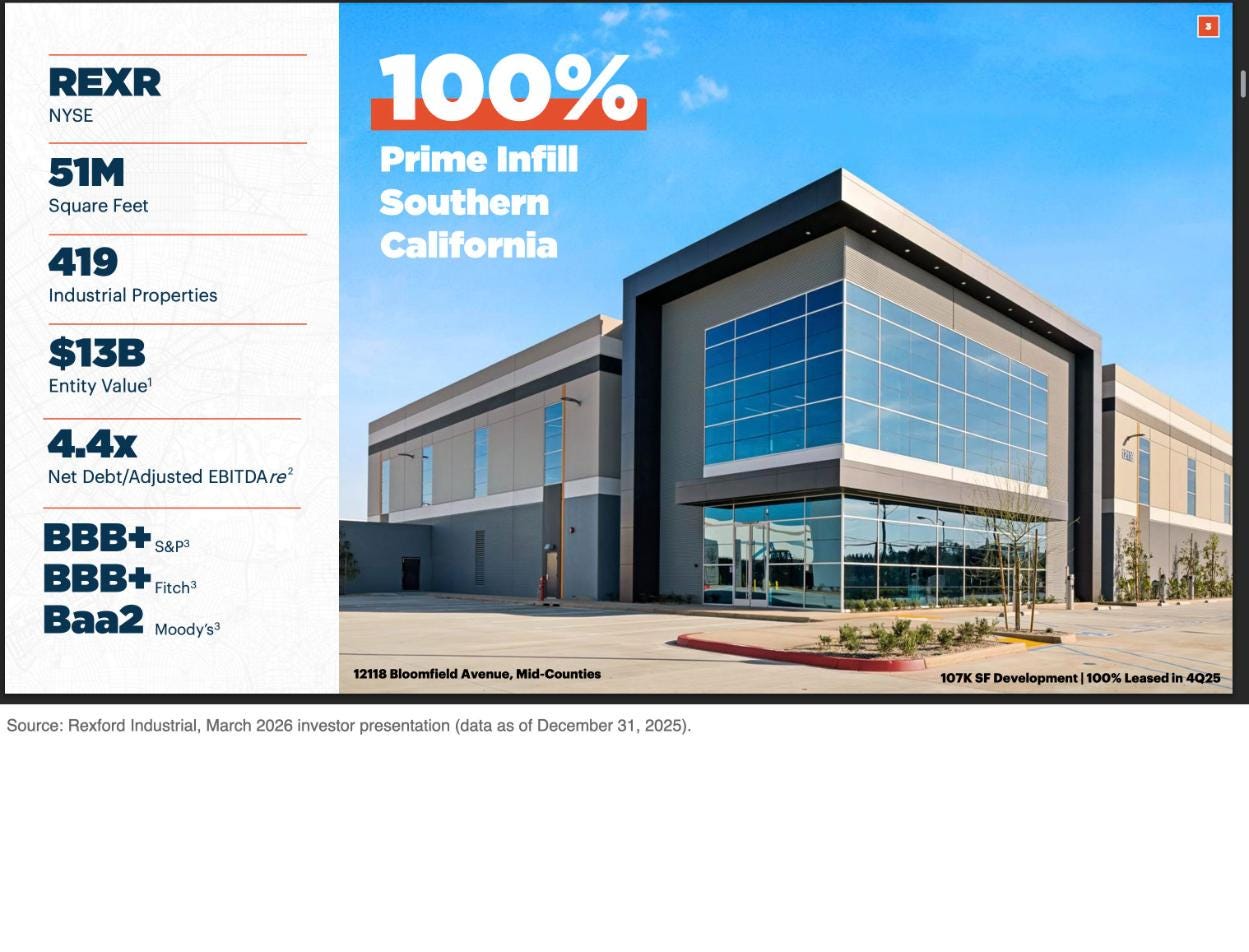
From Rexford’s March 2026 investor presentation, with figures as of December 31, 2025:
The assets. 51 million square feet across 419 industrial properties, all in infill Southern California.
The size of the claim. Preferred dividends were $2.3 million in the fourth quarter, about $9.3 million a year. Adjusted EBITDAre in that one quarter was $177.8 million.
What ranks ahead. Debt. Net debt is 4.4x adjusted EBITDAre, roughly $3.1 billion by our math.
What ranks behind. The common stock. Rexford puts its entity value at $13 billion, which left more than $9 billion of common equity value beneath the preferred at year end. The common dividend has to be cut to zero before a preferred dividend can be skipped.
The balance sheet
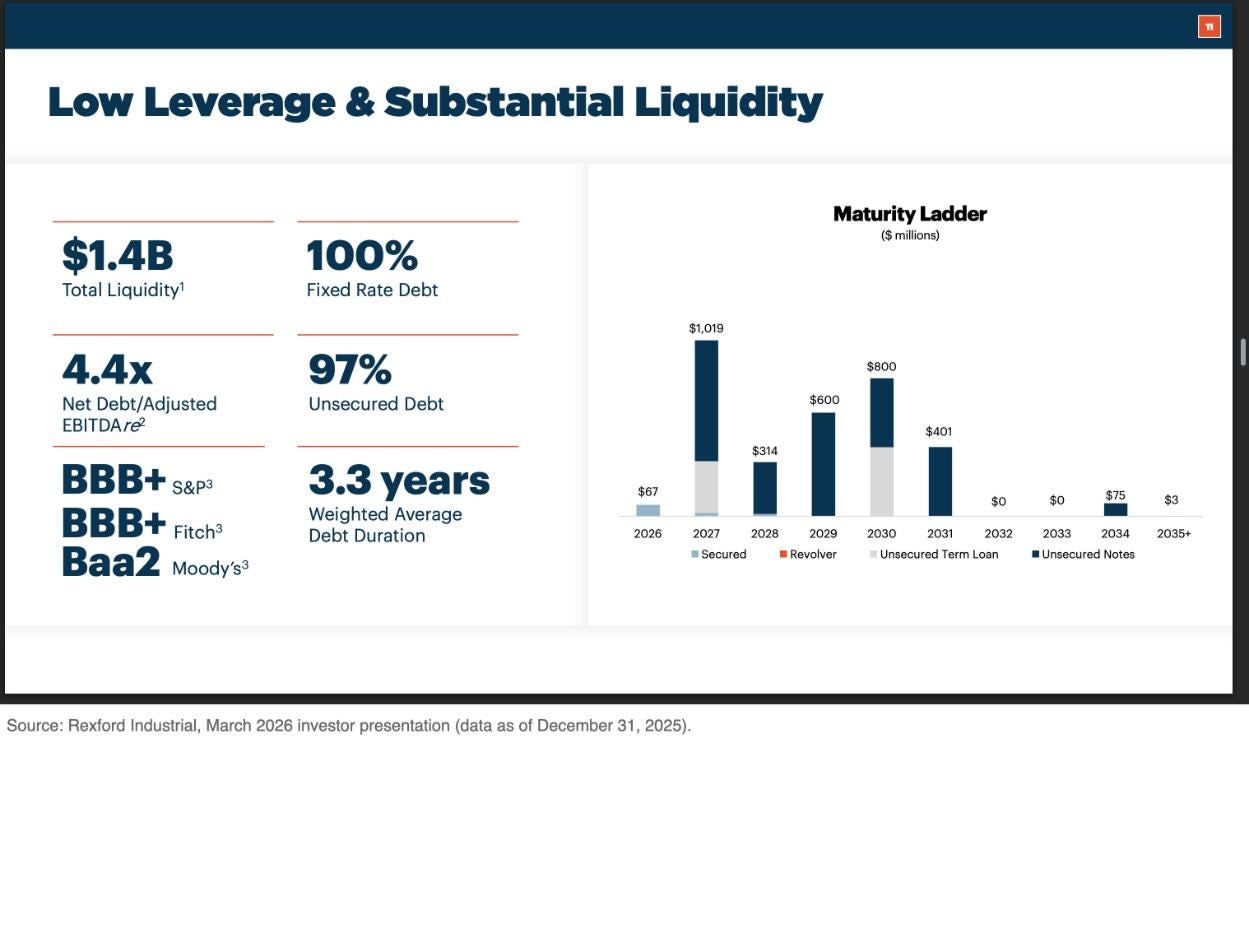
Investment grade. BBB+ from S&P and Fitch, Baa2 from Moody’s. These are the company’s credit ratings, not ratings on the preferred.
Liquidity. $1.4 billion, most of it an undrawn $1.25 billion credit line.
No floating-rate debt. 100% of debt is fixed rate and 97% is unsecured.
The date to watch. About $1.0 billion of debt comes due in 2027, the largest year on the maturity ladder. Average debt duration is 3.3 years.
What could go wrong
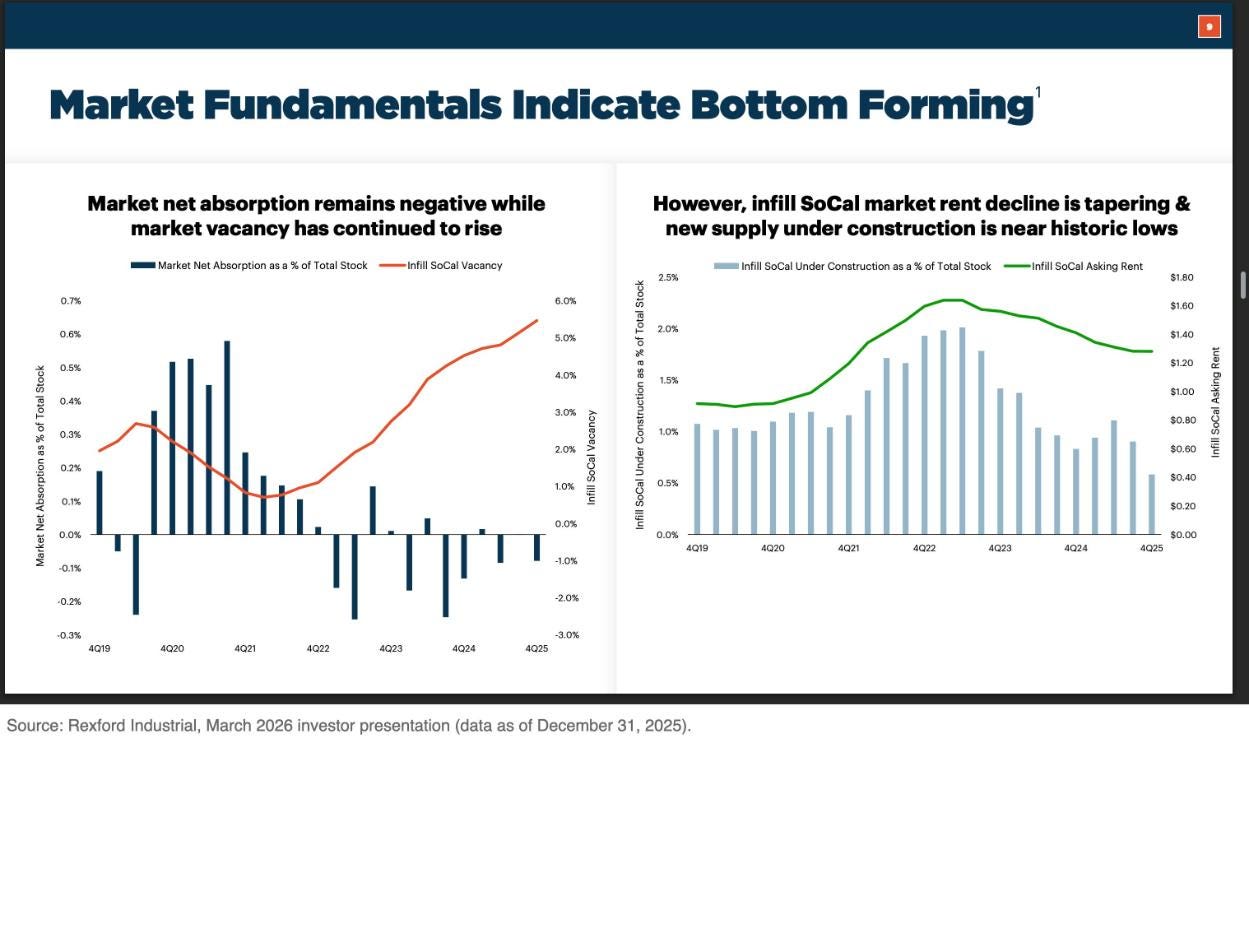
The market is soft. Rexford’s own slides show Southern California vacancy still rising, net absorption negative and asking rents falling, though more slowly. The offset is supply: new construction is near historic lows.
2026 is guided down. Management expects same-property NOI to fall 1.5% to 2.5% and Core FFO of $2.35 to $2.40 a share, flat to slightly below the $2.40 earned in 2025.
One region. Every property is in Southern California. One large tenant, Tireco, renewed early at a cash rent about 30% lower. Rexford says that is not typical of the portfolio.
Change at the top. A new CEO and COO took over in April 2026. The fourth quarter of 2025 showed a net loss after $89 million of real estate impairments and $60 million of co-CEO transition costs.
Risks that come with any preferred. There is no maturity, so the price moves with interest rates. Rexford can redeem either series at $25, which caps the upside. Each issue is small, so trading can be thin.
The trade-off
What you get: a fixed dividend, a small claim on a large investment-grade landlord, and a place in line ahead of the common stock.
What you give up: the growth. A preferred dividend never rises, and if Southern California rents recover, that upside goes to common shareholders.
Sources: Rexford Industrial March 2026 investor presentation; preferred terms from company filings. Evergreen Income is general research, not personal advice. [ADD disclosure of any Evergreen or personal position in REXR securities.]